Suiren Japanese Language Center Pvt. Ltd. is a leading Japanese language institution in Nepal dedicated to preparing students for academic, professional, and cultural success in Japan.
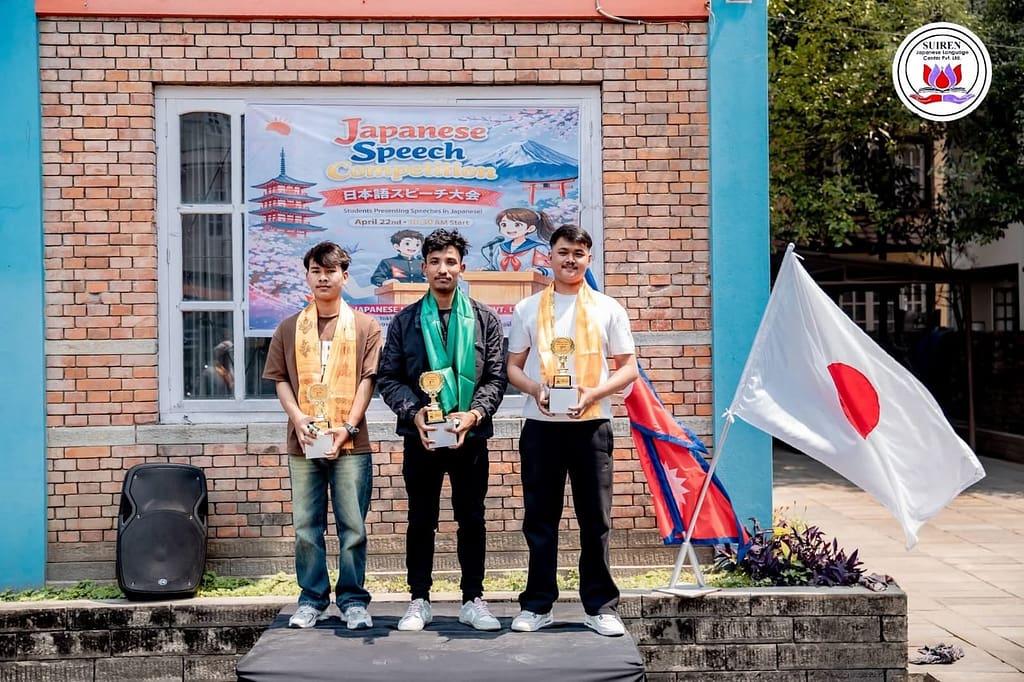
At Suiren Japanese Language Center, we believe language learning goes far beyond the classroom. Fluency is built in moments of real pressure — standing in front of an audience, finding the words, and delivering them with confidence. That belief is exactly what drove us to organize our first-ever Japanese Speech Competition.
What the Competition Was About
The event brought together students from across Suiren’s batches to compete in a structured Japanese speech competition. Each participant prepared and delivered their speech entirely in Japanese — a genuine test of vocabulary, pronunciation, grammar, and the kind of composure that no textbook exercise can replicate.
The competition wasn’t just about who spoke the best Japanese. It was about growth — pushing students to apply everything they’ve been learning in a high-stakes, real-world setting.
The Jury Panel
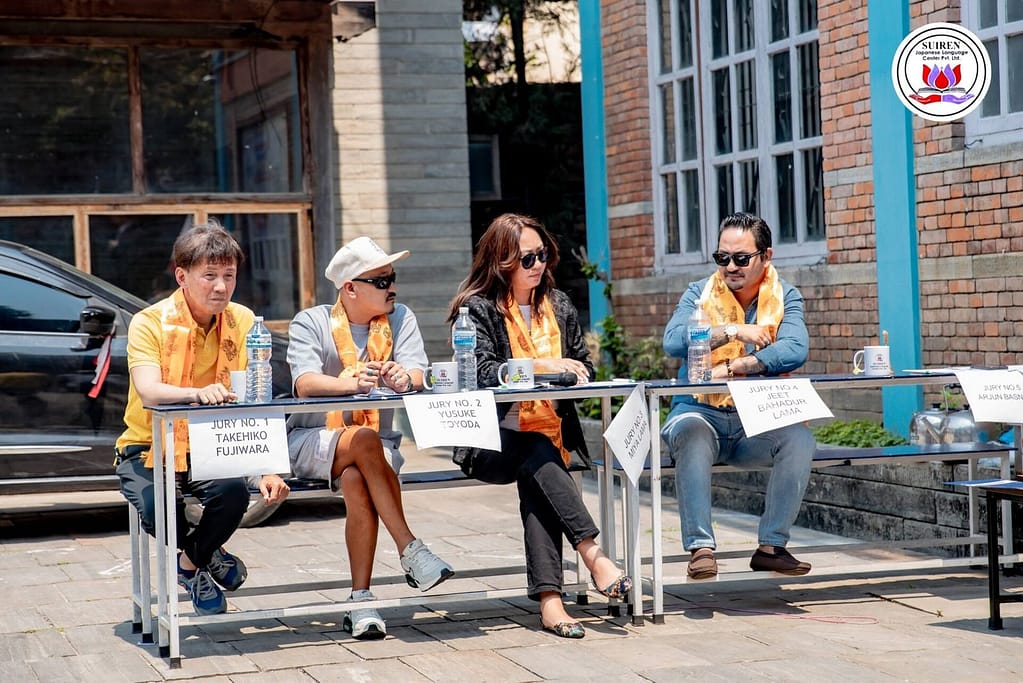
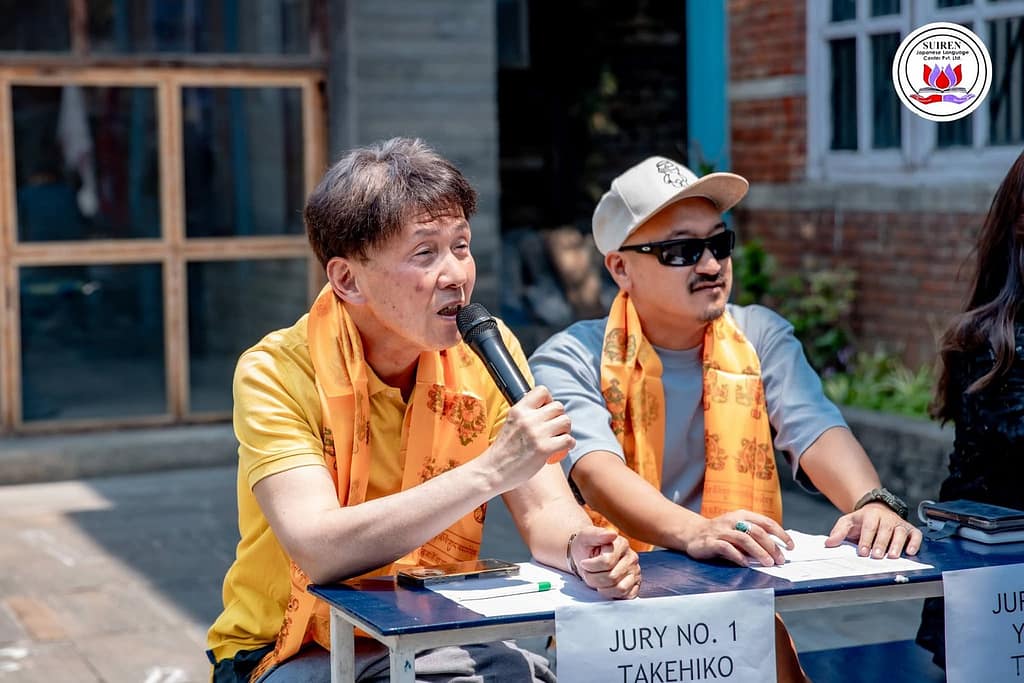
The competition was evaluated by a distinguished panel of five jury members:
Takehiko Fujiwara — Educational Foundation Mirai School Vice-Director
Yusuke Toyoda — Japanese national, assessing delivery and language accuracy
Miya Lama — Co-Founder of Suiren Japanese Language Center, native Japanese speaker
Jeet Bahadur Lama — CEO & Founder of Suiren, judging overall impact and communication
Arjun Basnet — Rounding out the panel with additional perspective
Having two native Japanese speakers and Suiren’s own founders on the jury ensured that students received feedback grounded in real Japan standards — not just classroom expectations.
Why Events Like This Matter
For most Nepali students, Japan isn’t just a study destination — it’s a life decision. Getting there requires passing language proficiency tests like JLPT and JFT-Basic. But passing a test and actually communicating in Japan are two very different things.
Events like this speech competition are designed to close that gap. When a student stands up, faces a jury, and speaks Japanese for several minutes without a script to hide behind, they discover something important: they can do it.
That confidence — built here in Kathmandu — is what carries them through visa interviews, school orientations, and daily life in Japan.
What’s Next
This is just the beginning. We plan to make events like these a regular part of the Suiren experience — competitions, cultural exchanges, practice sessions with native speakers, and more.
If you’re a prospective student wondering what studying at Suiren actually looks like, this is it: a community that invests in you beyond the classroom.
Whether you are applying for a student visa to study in Japan or an SSW visa to work there, the quality of your documentation and your interview performance can determine the outcome of your entire application. Many qualified candidates face rejections not because they lack eligibility, but because their paperwork was poorly organized, their financial documents were inconsistent, or they struggled to articulate their intentions clearly during the interview.
At Suiren Japanese Language Center, we have seen firsthand how proper documentation and interview preparation transform application outcomes. This guide covers everything you need to know about preparing a strong, credible application package.
Why Documentation Matters More Than You Think
Japanese immigration authorities are thorough and detail-oriented. They evaluate not just whether you meet the basic requirements, but whether your entire application tells a consistent, credible story. A single discrepancy between your financial documents and your stated plans, or an unclear explanation of a gap in your academic history, can raise questions that lead to delays or rejections.
The good news is that with proper preparation, these issues are entirely preventable. The key is to approach your documentation as a complete narrative — every document should support and reinforce the same story.
Essential Documents for Japan Visa Applications
For Student Visa Applications
Valid passport with at least 6 months remaining validity
Certificate of Eligibility (COE) — original copy issued by Japanese immigration
Admission letter from your Japanese institution
Completed visa application form with passport-sized photographs
Academic transcripts and certificates (SEE, Plus-2, and any higher education) — attested by Notary Public
Nepali citizenship certificate (attested copy)
Financial documents: bank statements (minimum 6 months), income certificates, property valuation documents
Sponsor documents (if applicable): relationship proof, sponsor’s income and employment details
Statement of purpose explaining why you want to study in Japan
JLPT certificate (if available) — strengthens your application even if not mandatory
For SSW Visa Applications
Valid passport
Certificate of Eligibility from employer in Japan
Employment contract with Japanese employer
JLPT N4 or JFT-Basic certificate
Sector-specific skills test pass certificate
Medical examination report
Police clearance certificate
Completed visa application form with photographs
Common Documentation Mistakes and How to Avoid Them
Mistake
Why It Causes Problems
How to Avoid It
Inconsistent financial figures
Raises suspicion about the authenticity of your financial support
Ensure all bank statements, income certificates, and sponsor letters present a consistent financial picture
Missing attestation on academic documents
Unattested documents are not accepted by the embassy
Get all transcripts and certificates attested by Notary Public well in advance
Unexplained gaps in academic or work history
Creates doubt about your background and intentions
Prepare a clear written explanation for any gaps, including what you were doing during that period
Poorly written statement of purpose
Fails to demonstrate genuine motivation and clear plans
Write a specific, personal statement that connects your background to your goals in Japan
Last-minute document preparation
Leads to errors, missing items, and unnecessary stress
Begin assembling documents at least 2–3 months before your intended submission date
The Interview: What to Expect and How to Prepare
Not all visa applications require an interview, but when one is requested, it plays a significant role in the decision. Embassy officials use the interview to assess the genuineness of your application, the clarity of your plans, and your basic communication abilities.
Common Interview Questions
While specific questions vary, the following themes come up frequently in Japan visa interviews:
Why do you want to study or work in Japan specifically? (Be specific — generic answers like “because Japan is a developed country” are not convincing)
What school or employer are you going to, and why did you choose them?
What are your plans after completing your studies or work period?
Who is sponsoring your stay, and what is their financial situation?
How much do you know about life in Japan? (Demonstrates genuine interest and preparation)
Do you have any Japanese language ability? (Even basic greetings in Japanese show effort and sincerity)
Interview Tips for Success
Be honest and consistent: Your answers should match the information in your documents. Any contradiction raises immediate red flags.
Be specific: Instead of saying you want to “learn Japanese culture,” explain exactly what you plan to study, where, and how it connects to your career goals.
Stay calm and confident: Nervousness is natural, but practice helps. Speak clearly, maintain eye contact, and take a moment to think before answering if needed.
Dress professionally: First impressions matter. Business casual or formal attire is appropriate.
Bring supporting documents: Even if the interview is informal, having copies of your key documents shows preparation and seriousness.
How Suiren’s Support Makes the Difference
Suiren Japanese Language Center provides comprehensive interview and documentation support that covers every aspect of the process. Our services include a complete document review and checklist verification to ensure nothing is missing, statement of purpose writing guidance tailored to your specific situation, mock interview sessions that simulate real embassy interview conditions, financial document consultation to ensure consistency and completeness, and post-submission tracking and guidance.
Our unique advantage is our binational perspective. With a Nepali founder who understands the local education system and documentation practices, and a Japanese co-founder who understands what Japanese authorities look for, we bridge the gap that many applicants fall into.
Do not leave your application to chance. Contact Suiren Japanese Language Center today for expert documentation review and interview preparation. One consultation can make the difference between an approval and a rejection.
For most Nepali students heading to Japan, the journey begins at a Japanese language school. These institutions serve as the foundation for everything that follows — whether you plan to enter a Japanese university, pursue vocational training, or transition into a career through programs like the Specified Skilled Worker (SSW) visa.
Choosing the right language school is one of the most important decisions you will make. The school you attend will determine the quality of your language education, your living environment, the part-time work opportunities available to you, and your overall experience in Japan. This guide helps you understand what to look for and how to make the best choice.
Why Start at a Japanese Language School?
Japanese language schools serve multiple purposes beyond just teaching the language. They provide the visa sponsorship you need to enter Japan as a student. They prepare you for JLPT certification, which is required for university admission and many job opportunities. They help you adapt to Japanese culture, customs, and daily life. Many schools also offer career guidance and university placement support.
For Nepali students in particular, language schools are the most accessible entry point into Japan’s education system. Most programs run for one to two years, with major intake periods in April, July, October, and January.
Understanding Japan’s Intake System
Intake Month
Course Duration
Best For
April
2 years
Students who want the longest study period and maximum preparation time
July
1 year 9 months
Students who just missed the April deadline
October
1 year 6 months
Popular intake; good balance of study time and cost
January
1 year 3 months
Students with some existing Japanese knowledge who want a shorter program
The April intake is the most popular because it aligns with Japan’s academic year and provides the full two-year study period. However, each intake has its advantages depending on your preparation level and timeline.
What to Look for in a Japanese Language School
1. Location
Japan’s language schools are spread across the country, but the most popular locations for Nepali students are Tokyo, Osaka, Fukuoka, and Nagoya. Tokyo offers the widest range of part-time work opportunities but has higher living costs. Regional cities like Fukuoka and Sapporo offer lower costs of living while still providing good job markets.
2. Curriculum Quality
Look for schools that offer JLPT-focused preparation, university entrance exam (EJU) preparation if you plan to pursue higher education, and conversation-based learning alongside textbook study. Schools accredited by the Association for the Promotion of Japanese Language Education maintain specific quality standards.
3. Student Support Services
The best language schools provide comprehensive support including airport pickup, accommodation arrangement, help with opening a bank account and getting a phone, part-time job placement assistance, and counseling services for academic and personal matters.
4. Part-Time Work Support
Japanese student visa holders are permitted to work up to 28 hours per week during the academic term. Many Nepali students rely on part-time work to support their living expenses. Schools located in areas with strong job markets for international students — such as restaurants, convenience stores, and logistics — offer a practical advantage.
5. Track Record
Ask about the school’s student demographics, JLPT pass rates, university placement rates, and dropout rates. A school with a strong track record of Nepali student success is a good indicator of the support you can expect.
Costs to Expect
Studying at a Japanese language school involves several cost components:
Cost Item
Approximate Range (First Year)
Tuition fees
JPY 600,000 – 800,000
Admission and enrollment fees
JPY 50,000 – 100,000
Textbooks and materials
JPY 20,000 – 40,000
Accommodation (dormitory)
JPY 30,000 – 50,000 per month
Living expenses
JPY 80,000 – 120,000 per month
Total first year (approximate)
NPR 15,00,000 – 25,00,000
Many schools offer payment plans, and part-time work income can significantly offset your living expenses. Some schools also offer attendance-based scholarships and tuition reductions for high-performing students.
How Suiren’s Placement Service Works
Suiren Japanese Language Center has partnerships with trusted language schools across Japan. Our placement process includes a personal consultation to understand your goals, budget, and preferences, followed by school recommendations matched to your profile. We handle the complete application and documentation process, coordinate COE processing with the school, provide pre-departure briefing covering everything from airport procedures to your first week in Japan, and maintain post-arrival check-ins to make sure you are settling in well.
Because our co-founder is Japanese, we have direct relationships with schools in Japan that many other consultancies cannot offer. This means better communication, faster processing, and stronger advocacy on your behalf.
Looking for the right Japanese language school? Let Suiren match you with a school that fits your goals. Book a free consultation today and take the first step toward your life in Japan.
Japan has become Nepal’s number one study destination. In the fiscal year 2023/24, more than 34,700 Nepali students received No Objection Certificates (NOCs) for Japan — surpassing Canada, Australia, the United Kingdom, and the United States combined. This remarkable growth reflects not only Japan’s world-class education system but also the expanding opportunities for Nepali youth in one of Asia’s most advanced economies.
However, the visa application process can feel overwhelming. From obtaining a Certificate of Eligibility to preparing your financial documents and navigating the embassy submission, each step requires precision and careful planning. This guide walks you through the entire process so you know exactly what to expect.
Types of Student Visas for Japan
Japan offers different visa categories depending on your educational pathway:
Pre-College Student Visa: For students enrolling in Japanese language schools or preparatory programs. This is the most common starting point for Nepali students and can later be converted to a College Student Visa.
College Student Visa: For undergraduate, postgraduate, and doctoral programs at universities, junior colleges, and specialized training colleges. The duration matches your program length.
Most Nepali students begin with a language school visa, build their Japanese proficiency, and then progress to higher education or transition to work opportunities including the SSW pathway.
Eligibility Requirements
To apply for a Japanese student visa from Nepal, you must meet several key criteria:
Age: You must be at least 18 years old. For Plus-2 graduates, the general guideline is up to 24 years; for Bachelor’s graduates, up to 28 years; and for Master’s graduates, up to 32 years.
Education: You must have completed at least 12 years of schooling (SEE plus Plus-2 or equivalent).
Japanese Language Proficiency: While not always mandatory, having JLPT certification (particularly N5 or N4) significantly strengthens your application and demonstrates serious intent.
Financial Capacity: You or your sponsor must demonstrate the ability to cover tuition, living expenses (approximately JPY 80,000 to 120,000 per month), and return airfare. A bank balance of NPR 8 to 10 lakh or more is generally expected.
Clean Background: No criminal record or previous immigration violations.
The Visa Application Process: Step by Step
Step 1: Choose Your School and Apply
Research Japanese language schools or universities that match your goals. Consider factors like location, course offerings, tuition fees, part-time work availability, and support services for international students. Suiren Japanese Language Center works with a network of affiliated language schools across Japan and can help you select the right institution.
Step 2: Obtain Your Certificate of Eligibility (COE)
The COE is the most critical document in the process. It is issued by the Immigration Services Agency of Japan and confirms that you meet the requirements for your visa category. Your school in Japan typically applies for this on your behalf. Processing takes one to three months, so early application is essential. As of 2023, Japan has also introduced digital COEs, which can be sent electronically to speed up the process.
Step 3: Prepare Your Documents
Once you receive your COE, you will need to assemble the following documents for your embassy submission: valid passport, Certificate of Eligibility (original), admission letter from your Japanese institution, completed visa application form, passport-sized photographs, financial documents (bank statements, income certificates, property valuations), academic transcripts and certificates (attested by Notary Public), and citizenship certificate.
Step 4: Submit at the Japanese Embassy
Submit your complete application at the Embassy of Japan in Kathmandu or through the VFS Global visa application center. Processing typically takes five to ten business days, though it can take longer in complex cases. The visa fee for Nepali nationals is determined based on entry type and is payable at the time of application.
Step 5: Pre-Departure Preparation
Once your visa is approved, it is time to prepare for departure. This includes booking flights, arranging accommodation in Japan, attending pre-departure orientation, purchasing travel insurance, and setting up your initial finances. Suiren provides comprehensive pre-departure guidance to ensure you are fully prepared for your new life in Japan.
Why Applications Get Rejected — and How to Avoid It
Understanding common rejection reasons helps you submit a stronger application:
Insufficient or inconsistent financial documents: Ensure your bank statements, income sources, and sponsorship letters are clear, consistent, and well-documented.
Weak language preparation: Students with no Japanese language study history may raise concerns about their seriousness. Even a basic JLPT N5 certificate demonstrates commitment.
Incomplete documentation: Missing even one required document can delay or derail your application. Always double-check against the official checklist.
Gaps in academic history without explanation: If there are gaps between your studies, prepare a clear written explanation.
Generic or unconvincing statement of purpose: Your reasons for studying in Japan should be specific, personal, and connected to your career goals.
The visa success rate for genuine Nepali students with complete documentation is approximately 85 to 90%. With proper preparation and guidance, the odds are strongly in your favor.
How Suiren Helps You Through the Process
At Suiren Japanese Language Center, we do not just teach Japanese — we guide you through every step of the visa journey. Our support includes institution selection and application assistance, document preparation and review, COE application coordination with our partner schools in Japan, embassy submission guidance, pre-departure orientation, and ongoing support even after you arrive in Japan.
Our founders — a Nepali-Japanese couple — bring a unique understanding of both sides of the process, ensuring that nothing gets lost in translation.
Planning to study in Japan? Start your journey with Suiren. Contact us today for a free counseling session. We will help you choose the right school, prepare your documents, and submit a strong application.
If you are planning to study or work in Japan, one of the most important milestones on your journey is passing the Japanese Language Proficiency Test (JLPT). Whether you are just beginning to learn hiragana or aiming for advanced fluency, the JLPT serves as the globally recognized standard that universities, employers, and immigration authorities in Japan use to evaluate your language skills.
At Suiren Japanese Language Center, we have helped hundreds of students prepare for and pass the JLPT — and our structured preparation classes are designed specifically for Nepali students who want to achieve their best scores.
What is the JLPT?
The Japanese Language Proficiency Test is administered jointly by the Japan Foundation and Japan Educational Exchanges and Services (JEES). It was first introduced in 1984 and has since become the most widely accepted certification of Japanese language ability for non-native speakers around the world.
The JLPT is offered twice a year — typically on the first Sunday of July and the first Sunday of December. In 2026, the expected dates are July 5 and December 7. Registration usually opens in March for the July exam and September for the December exam, so planning ahead is essential.
Understanding the Five JLPT Levels
The test is structured into five progressive levels, each representing a different stage of proficiency:
Level
Proficiency
Who Should Take It
N5
Basic Japanese
Absolute beginners who can read hiragana, katakana, and basic kanji
N4
Elementary
Students who can understand basic conversations and read simple texts; required for SSW visa
N3
Intermediate
Students who can handle everyday Japanese situations with reasonable confidence
N2
Upper Intermediate
Required for most university admissions and professional roles in Japan
N1
Advanced
Near-native proficiency; needed for specialized academic and corporate careers
Important for SSW Visa Applicants: If you plan to work in Japan under the Specified Skilled Worker (SSW) program, you must pass at least JLPT N4 or the JFT-Basic test. Starting your preparation early gives you a significant advantage.
Why Structured JLPT Preparation Matters
Many students attempt to prepare for the JLPT on their own using textbooks and online resources. While self-study can be part of your strategy, research and experience consistently show that students who follow a structured preparation course achieve significantly better results. Here is why:
A trained instructor can identify your weak points early and adjust your study plan accordingly
Classroom learning provides regular practice with listening comprehension, which is the section most students struggle with
Timed mock exams simulate real test conditions, helping you develop the pacing skills needed to complete each section within the time limit
Group learning creates motivation and accountability that solo study cannot replicate
Expert guidance on exam strategies — such as elimination techniques and reading shortcuts — can make the difference between a marginal fail and a clear pass
How Suiren Prepares You for JLPT Success
At Suiren Japanese Language Center, our JLPT preparation classes are designed around a proven curriculum that covers every aspect of the exam. Our approach includes daily vocabulary building of 15 to 20 new words and kanji, systematic grammar drills organized by JLPT level, weekly reading practice using real JLPT-style passages, daily listening exercises using authentic Japanese audio, and regular full-length mock tests under timed conditions.
Our classes are taught by experienced Japanese language instructors, including native Japanese speakers who bring authentic pronunciation and cultural understanding into every lesson. This is particularly valuable for the listening section, where understanding natural spoken Japanese — not just textbook Japanese — is essential.
Recommended Study Timeline
Target Level
Recommended Preparation Time
Ideal Starting Point
N5
3 months of consistent study
Complete beginners
N4
6 months (or 3 months after N5)
Students with basic hiragana/katakana
N3
6–9 months
Students who have passed N4
N2
9–12 months
Students with intermediate-level Japanese
N1
12+ months
Advanced students aiming for university or professional careers
Common Mistakes to Avoid
Based on our years of experience teaching JLPT preparation, here are the most frequent mistakes we see students make:
Neglecting listening practice: Many students focus heavily on reading and grammar but underestimate the listening section, which requires daily practice with natural-speed Japanese
Cramming instead of consistent study: The JLPT rewards steady, long-term preparation rather than last-minute cramming
Memorizing without understanding: Learning vocabulary and grammar rules without understanding how they are used in context leads to poor performance on application-based questions
Ignoring time management: At higher levels, poor pacing can cost you the entire reading section; always practice under timed conditions
Skipping mock tests: Full-length practice exams are one of the most effective preparation tools available
Your Next Step
Whether you are targeting N5 as your first step or preparing for N2 to support a university application, Suiren Japanese Language Center is here to guide you. Our structured JLPT preparation classes give you the knowledge, practice, and confidence to walk into the exam room ready to succeed.
Ready to start your JLPT preparation? Contact Suiren Japanese Language Center today for a free consultation and learn about our upcoming class schedules. Visit us in Kathmandu or Chitwan, or reach out via WhatsApp for immediate assistance.
Japan has quietly become Nepal’s most popular study destination — ahead of Canada, Australia, the UK, and the USA. In FY 2023/24 alone, 34,731 Nepali students received NOCs to study in Japan. That number was just 8,577 four years ago.
So what is driving this shift? Lower costs, the ability to work part-time while studying, a straightforward visa process, and a clear pathway to long-term work in Japan through the SSW visa.
If you are a Nepali student or parent trying to understand how the Japan study process actually works — from the first decision to the day you land in Tokyo — this guide is for you..
Step 1: Decide Your Goal
Before choosing a school or applying for a visa, you need to be clear about what you want from Japan.
Are you going to Japan to study a specific field? Or is your primary goal to work part-time, earn money, and eventually transition to a full-time job or SSW visa after graduation? Both are valid — but your answer changes which school you choose and which city you target.
Japan offers Nepali students three common pathways:
Language School → University or Professional School: Study Japanese for 1–2 years at a language school, reach N2 level, then apply to a Japanese university or vocational college.
Language School → SSW Visa: Study Japanese to N4 level, pass the SSW skill test in your chosen sector (caregiving, food service, agriculture, hospitality), and transition directly to work.
Vocational/Professional School: Apply directly to a specialized school in fields like IT, design, cooking, business, or nursing — usually requires at least N2 Japanese level at entry.
Step 2: Choose Your School and City
Japan has language schools in every major city. For Nepali students, the most accessible and popular cities are:
Tokyo: The largest city, most job opportunities for part-time work, highest living costs. Ideal for students who want maximum exposure and work earnings.
Osaka: Japan’s second city, more affordable than Tokyo, vibrant culture, strong food and hospitality industry — excellent for students targeting SSW in food service.
Hiroshima: Quieter, more focused study environment, lower cost of living, strong local community support for international students.
Kobe: International port city, high quality of life, strong connections with healthcare and hospitality sectors.
Nara: Smallest and most affordable of the five, peaceful, excellent for students who want a traditional Japanese experience with lower expenses.
Your consultancy should help you match your goals, budget, and personality to the right city and school.
Step 3: Check Your Japanese Language Requirement
Most Japanese language schools accept students with zero prior Japanese knowledge — you will study from N5 level (beginner) and work upward.
However, if you are applying directly to a university or professional school, you typically need:
N2 level for most universities
N3–N4 level for many vocational schools
N4 level for the SSW visa pathway
Starting Japanese classes at least 6 months before your intended application date is strongly recommended. Even basic N5 knowledge makes the transition to Japan significantly easier.
Step 4: Prepare Your Documents
This is where most students lose time. Missing or incorrect documents are the most common reason for visa delays. Here is what you will need:
Personal documents:
Passport (valid for at least 18 months)
Birth certificate
Citizenship certificate
Academic certificates and transcripts (SLC/SEE, +2 or equivalent)
Character certificate from your last school
Financial documents:
Bank statement showing sufficient funds (typically NPR 8–12 lakhs minimum)
Property ownership documents if using family assets as proof
Sponsor letter if a family member is funding your studies
School-specific documents:
Completed application form from the Japanese school
Statement of purpose (why you want to study in Japan)
Study plan
Your consultancy will prepare and review all of these before submission. Never submit documents without professional review — a single mistake can delay your visa by months.
Step 5: Apply for the COE (Certificate of Eligibility)
This is the most important step in the Japan study visa process — and the one most Nepali students do not fully understand.
The COE (Certificate of Eligibility) is not applied for by you directly. Your Japanese school applies to Japan Immigration on your behalf after you have been accepted. This process takes approximately 1–3 months.
Once the COE is issued, it is sent to your consultancy in Nepal. You then submit it along with your visa application at the Japanese Embassy in Kathmandu.
The Embassy typically processes the visa within 5–7 working days after receiving the COE.
Important: The COE has an expiry date. You must travel to Japan before it expires. Do not delay after receiving it.
Step 6: Prepare for Departure
Once your visa is stamped, you have a few final steps before departure:
Purchase your flight ticket (buy early — Japan routes from Kathmandu book up quickly around April and October intakes)
Arrange accommodation (your school may help with dormitory options)
Open a Japanese bank account within the first week of arrival — this is required for receiving your part-time salary
Register at your local ward office (Juki) within 14 days of arrival — required by Japanese law
Get your residence card (Zairyu card) at the airport when you land
How Much Does It Cost to Study in Japan from Nepal?
This is the question every family asks first. Here is a realistic breakdown:
Expense
Annual Cost (NPR)
Language school tuition
3.5 – 5 lakhs
Living expenses
2 – 3.5 lakhs
Total per year
5 – 8 lakhs
Compare this to Canada (25–40 lakhs/year) or Australia (20–35 lakhs/year) and the cost difference is significant.
Part-time work rights: Japanese student visa allows you to work up to 28 hours per week. At typical student wages (JPY 1,000–1,200/hour), you can earn approximately NPR 50,000–80,000 per month, which covers most or all of your monthly living expenses.
Final Advice
Start early. The April intake requires applications by November–December of the previous year. The October intake requires applications by April–May. Students who begin the process late frequently miss their preferred intake.
Choose a consultancy that has a genuine success record — ask to see their visa granted list, ask about their COE success rate, and meet with their counselors before committing.
If you have questions about starting your Japan journey, Suiren Japanese Language Center offers free counseling sessions at our Kathmandu and Chitwan offices.